Market Pressures Behind Apple’s First China Store Closure
Apple’s decision to shutter its Parkland Mall store in Dalian on 9 August 2025 is more than a one-off real-estate adjustment—it crystallises the intersecting forces of declining consumer demand, surging domestic competition, and strategic supply-chain rewiring that are reshaping China’s electronics landscape123. For bloggers, the episode offers a vivid case study of how macro-economics, geopolitics, and retail dynamics now collide in the world’s largest smartphone market.

1. The Parkland Mall Exit: What Happened and Why
Apple confirmed that its Parkland Mall outlet—one of two stores in Dalian—will close permanently, marking the firm’s first mainland shutdown since retail operations began in 2008134. Management blamed “the departure of several retailers” after the complex was rebranded from Parkland to Intime City, a change that drained foot traffic and rent stability12. Staff are being redeployed to the nearby Olympia 66 store, preserving jobs while eliminating an under-performing location12.
2. A Mall in Decline
Parkland’s troubles pre-date Apple’s withdrawal: Michael Kors, Armani, Coach, Sandro and Hugo Boss all let leases lapse as discretionary spending cooled23. Local observers describe half-vacant floors and promotional discounts that failed to revive traffic—symptoms of a broader retail slowdown tied to weaker wage growth, youth unemployment near 16 percent, and heightened saving rates among Chinese households56.
3. Apple’s Greater-China Performance
The closure arrives after six consecutive quarters of shrinking Greater-China revenue, which slid 2.3 percent year-over-year to US $16 billion in Apple’s March quarter, well below the US $16.8 billion analyst consensus27. Regionally, China now contributes 16–17 percent of Apple’s global sales, down from above 20 percent at its 2022 peak37.
4. Domestic Rivals Surge Ahead
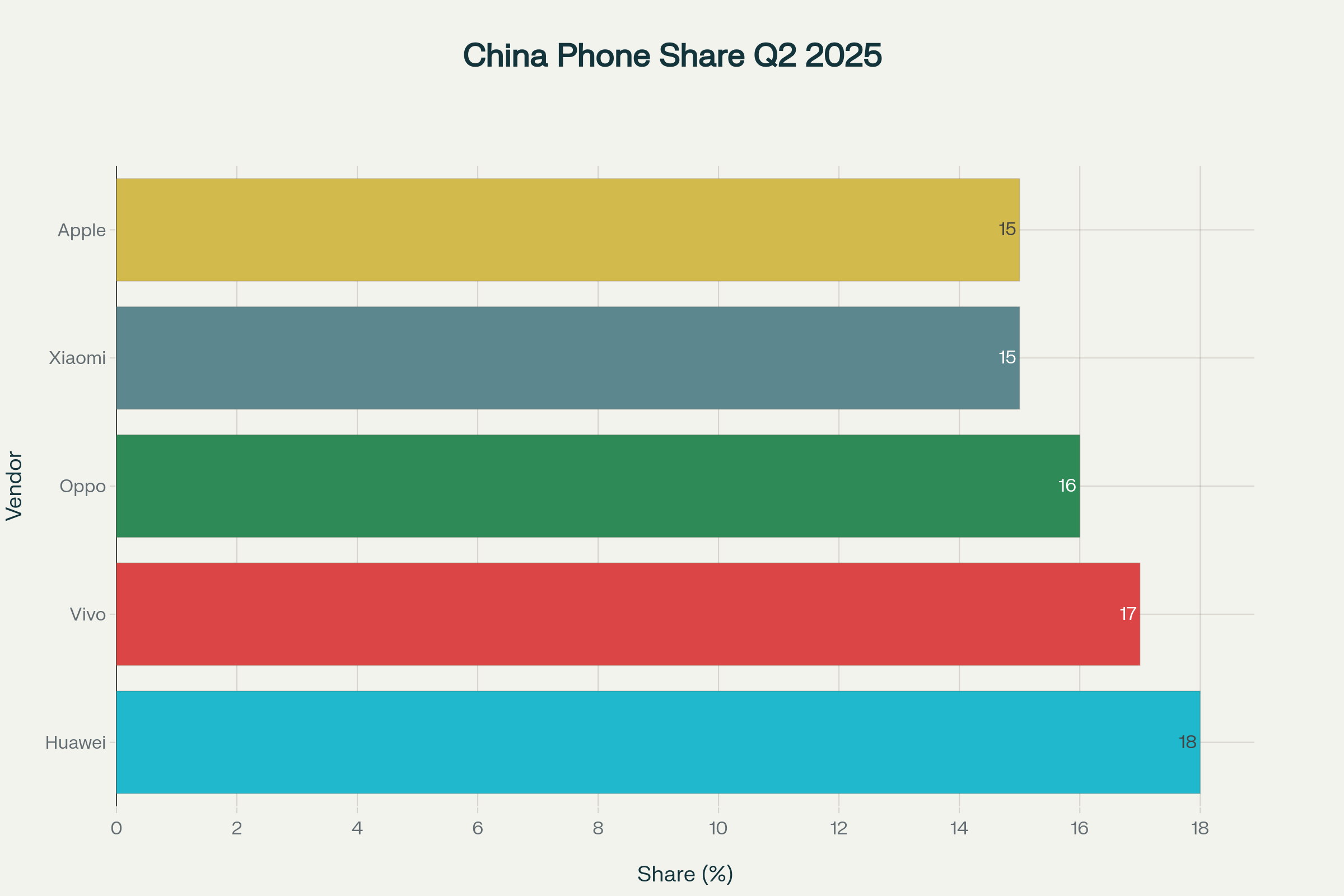
Chinese OEMs used subsidy-fuelled demand and aggressive AI-feature roll-outs to reclaim leadership in Q2 2025. Canalys data show Huawei on top with an 18 percent shipment share, trailed by Vivo (17 percent), Oppo (16 percent), Xiaomi (15 percent) and then Apple, also at 15 percent but ranking fifth due to decimal-point ordering89. Huawei’s HarmonyOS 5.0 devices and aggressive pricing were decisive advantages89.
5. Foreign Brands’ Vanishing Act
CAICT shipment logs for March 2025 paint an even starker picture: Chinese vendors captured 92 percent of domestic smartphone units, leaving non-Chinese brands—largely Apple—with just 8 percent after a near-50 percent year-over-year collapse in volume1011. First-quarter data show foreign shipments off more than 25 percent even as overall volumes grew 3.3 percent, underscoring how domestic subsidies and nationalist preferences have tilted the playing field1012.
6. Macro Headwinds and Deflationary Drag
China’s retail sales growth slowed to 4.8 percent in June, its weakest pace since February, while CPI remained in deflation for four straight months through May13614. Disposable-income growth has halved since 2020, pushing 61 percent of households to favour saving over spending5. Property prices continue to fall, eroding consumer wealth and confidence1514. These macro signals translate directly into lower mall visits and premium-device upgrades.
7. Apple’s China Strategy: Prune, Then Plant
Despite the Dalian retreat, Apple still runs 56 China stores—over 10 percent of its global footprint—and will open a new Shenzhen location on 16 August, followed by additional Beijing and Shanghai sites next year216. Globally, the company is slowing lease renewals while reallocating capital toward flagship sites with higher experiential value and toward online retail in emerging markets1617.
8. The “China Plus One” Supply-Chain Pivot
Trade tensions and threatened U.S. tariffs up to 145 percent accelerated Apple’s relocation of iPhone assembly to India, where made-in-India units now supply 44 percent of U.S. smartphone imports, up from 13 percent a year earlier181920. Apple aims to produce most U.S.-bound iPhones in India by 2026, even as Foxconn invests US $1.5 billion to scale Tamil Nadu capacity212223. While China remains indispensable for volume, the geographical diversification reduces single-country risk—and signals why marginal China store closures can be offset by growth elsewhere.
9. Takeaways for Your Blog Audience
-
Symbol over Size – Apple’s Parkland exit is tiny on a global scale yet symbolises diminishing foreign brand clout in a market once viewed as a growth engine1310.
-
Demand Downshift – Deflation, housing woes and income stagnation have trimmed discretionary spending, hurting high-ticket electronics retailers13615.
-
Local Leaders Resurgent – Subsidies capped at ¥6,000 favoured sub-premium Chinese models while HarmonyOS and rapid AI roll-outs sharpened domestic appeal2411.
-
Strategic Retrenchment, Not Retreat – Apple is pruning weak stores, boosting e-commerce, and re-investing in stronger Chinese cities while hedging supply chains through India22220.
-
Bloggable Angle – Readers can view the closure as a bellwether of shifting consumer sentiment and geopolitical risk, highlighting why strategic flexibility trumps sheer brand cachet in today’s China.
Conclusion
Apple’s first mainland store shutdown encapsulates the perfect storm of macroeconomic softness, protectionist subsidy regimes, and vigorous domestic innovation that now defines China’s retail tech arena1814. For bloggers, the story resonates far beyond Dalian: it is a living case of how even the world’s most valuable brand must adapt its retail footprint, pricing, and supply strategy to survive in an environment where local champions rise and consumers tighten their belts. Whether Apple’s selective pruning proves prescient or merely reactive will hinge on how fast it can refresh AI capabilities, localise experiences, and balance its China commitments against a rapidly scaling Indian nexus.
No comments